


Isabelle Sperano, Assistant professor in Design, MacEwan University, Edmonton, Canada
Leigh Rivenbark, Assistant professor in Theatre, MacEwan University, Edmonton, Canada
Jacynthe Roberge, Assistant professor in Design, Université Laval,Québec, Canada
Daniel Caja Rubio, Assistant professor in Design, Université Laval, Québec, Canada.

Introduction
To design quality digital products, designers need to understand the user and their experiences on a deep level (Ritter et al. 2014). To do so, design practitioners have developed research methods that mainly focus on an “intellectual” approach to gain insight through quantitative research and analysis. While useful, these approaches often undervalue the role of the body in the process of understanding the user. In response to this, a more embodied approach to user research has emerged. Methods such as roleplaying and bodystorming are increasingly used to gain new kinds of insight during the design process (Burns et al. 1994, Schleicher et al. 2010, Wakkary et al. 2007). However, designers often encounter limitations with these methods (Think Design 2021). Some have trouble engaging in role-playing exercises due to a lack of acting training. Others struggle to apply insights to their work.
Our team developed a workshop for design students exploring how acting techniques can be used as design methods to address these challenges. It was conducted in interaction design classes (Winter 2019 and Fall 2020) in 2 universities. Our goal at the Interaction Design Education Summit 2021 was to present this workshop to design instructors and practitioners so they can share it with their students or design teams. In this article, we describe an overview of the workshop and discuss potential benefits, challenges, and limitations of this approach to design.
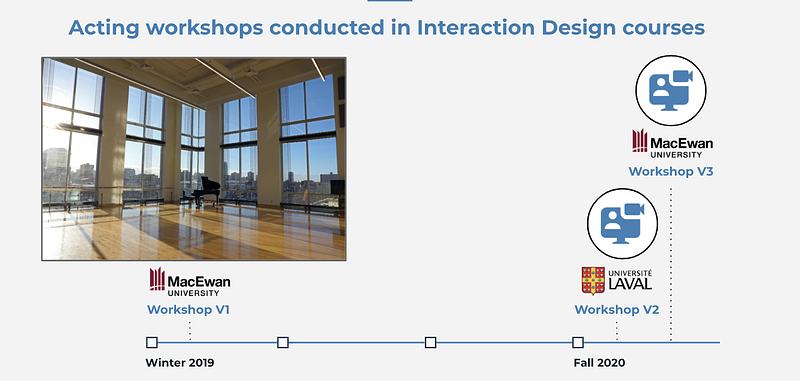
In this workshop, participants explored psychophysical exercises that strengthen the relationship between the mind (cognition) and the body (physicality). In the process, we examined how engaging the body helps designers gain intuitive insights about a user that they may not get from a more intellectual approach. In addition, our team shared insights from previous workshops and our teaching practices. The workshop was delivered online due to COVID-19.
This workshop had four main goals:
- discover an alternative way to gain empathy for a user
- develop embodiment skills to gain intuitive knowledge about a user
- prepare to engage in other embodied methods like roleplaying and bodystorming
- show how to use these techniques for interaction design education
Participants
Participants came from various countries (Canada, USA, France, Estonia, Guatemala, Netherlands) and backgrounds (education, aviation, government, etc.). They also had varied levels of experience in interaction design (from 1 to 15 years).

Workshop

The workshop was divided into 3 parts: Observe, Embody & Create and Reflect.
Part 1. In part 1, we discussed the mutual importance of observation in the acting and design processes and led participants through a series of practical warm-up exercises. We also introduced the concept of psychophysical connection (Chekhov 2019), which proposes an interrelationship between mind (psycho) and body (physical). A person’s psychology affects their physicality and vice versa.
We then asked the participants to put those concepts into practice. First, we asked them to work from the inside out and create the physicality of someone with a specific psychological state (confident, shy, egotistical, depressed, etc.). Then we identified the physical signifiers shared by most participants. Later, we asked participants to take an outside-in approach and stand in a high-power pose and describe how it made them feel. We also discussed a similar experiment conducted by Amy Cuddy and her colleagues at Harvard University (Carney et al. 2010), proving that adopting a high-power pose for two minutes can alter a person’s testosterone and cortisol levels.
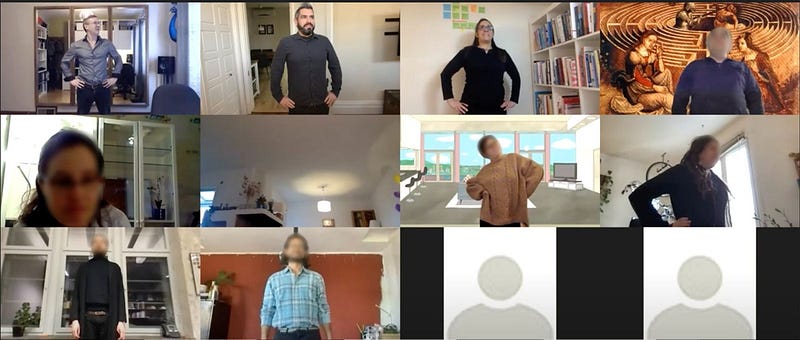
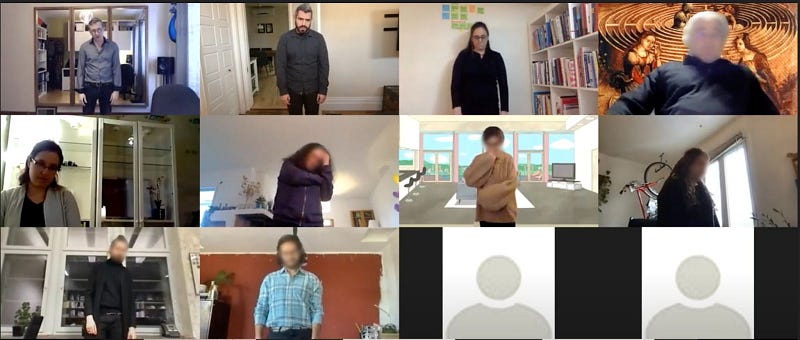
Part 2. In part 2, participants explored an adaptation of Emulating a Walk (Snow 2012), a well-known movement technique used by actors to create characters. We showed participants video clips of three different people — a carefree woman, a stylish man, and a curious toddler — and asked them to embody (or imitate) each person. The participants then shared their intuitive insights about potential emotions and thoughts of those people, based on their embodied experiences.

Part 3. In Part 3, we reflected on the usefulness and limitations of this embodied approach to user research and its potential contributions to interaction design education in these perilous times. Below are the main takeaways from the discussion with participants.
Potential benefits
Participants commented that it took them out of their comfort zone. One participant added that this is a good thing because designers tend to want to stay in their comfort zone, especially in the corporate world.
Others talked about the importance of understanding their own biases when designing for others. The workshop allowed them to look at others but also at themselves, which made them realize some of their biases.
Participants indicated that using these techniques in the classroom could help students learn to empathize more with the people they are designing for. They also noted that part 1 of the workshop, gave them tools to conduct deeper observation sessions.
Some talked about this workshop as a way to get students “in the mood” to design and into the heads of their users. They also noted how important it is to be playful when designing and that this approach would help get in that state.
Some confessed that the workshop made them realize roleplaying can give designers more insights than they had anticipated. They discovered that the body is an instrument you can use to understand others. This reminded them that they are not only “brains” but also “bodies” which is something one can forget, especially when everyone is working remotely, spending a lot of time in front of a computer.
Participants finally noted that these exercises could be useful for anyone building a product or a service for other people. Professionals working in engineering, computer science, business, and management, for example, could benefit from similar workshops.
Challenges and Limitations
The discussion led to exploring potential challenges and limitations when conducting such workshops.
One participant talked about the importance of being aware of potential psychological effects of using embodying techniques because they have the ability to stir emotions. This means, for example, being mindful of the types of poses or people to embody, and maybe giving students options from which to choose.
Some participants also talked about the importance of linking these acting exercises to concrete design projects to help designers connect the dots between disciplines. Our team did this when we conducted previous workshops at MacEwan University but opted to omit this element in the Education Summit workshop due to limited time.
There were also nuanced and interesting discussions about the importance or lack of importance of a person’s baseline personality when designing a product or service. As the conversation evolved, some participants recommended choosing relevant moments of a user’s life to embody, mainly in relation to the product they are using or a specific task they are doing. Also, it is important to note that how people physically react to a situation could vary depending on the person’s culture and background.
Finally, we all agreed that these techniques are not meant to replace existing research methods but to complement them, which, in turn, will give a richer picture of the users.
References
Burns, C., Dishman, E., Verplank, W. et Lassiter, B. (1994). « Actors, hairdos & videotape — informance design », CHI 94, Boston (MA), p. 119–120.
Carney, Dana R.; Cuddy, Amy J. C.; Yap, Andy J. (October 2010). “Power Posing — Brief Nonverbal Displays Affect Neuroendocrine Levels and Risk Tolerance”. Psychological Science. 21 (10): 1363–1368.
Chekhov, M. (2019). To the Actor: On the Technique of Acting. DigiReads.
Ritter, F. E., Baxter, G. D. et Churchill, E. F. (2014). Foundations for designing user-centred systems. What system designers need to know about people, Londres, Springer, 442 p.
Schleicher D., Jones, P. et Kachur, O. (2010). « Bodystorming as Embodied Designing », Interactions, 17 (6), p. 47–51.
Snow, J. (2012). Movement Training for Actors. Methuen Drama.
THINK DESIGN (2021). « Bodystorming », Web page, from think.design, retrieved June 16, 2021, in https://think.design/user-design-research/bodystorming/.
Wakkary, R., Poon, M., Maestri, L., Kirton, T., Corey, J. et Betts, R. (2007). « How Informances Can be Used in Design Ethnography », Conference on Human Factors in Computing Systems (CHI 2007), San Jose (CA), p. 1875–1880.
