Best in Category: Empowering
Interaction Awards 2021
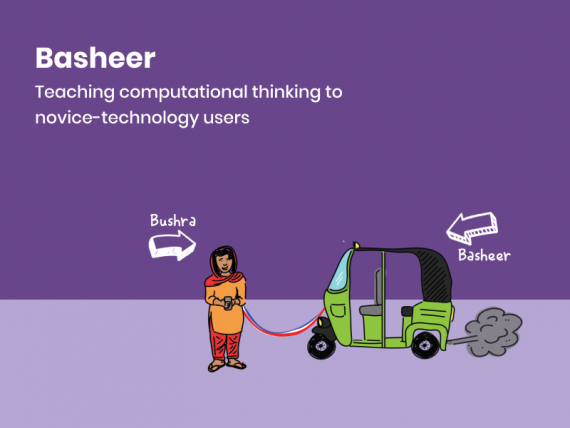
Basheer is a smartphone game designed to teach computational thinking to novice technology users. It gives an accessible and culturally relevant experience in which the learner solves various puzzles in a programming language in the user’s native language: Urdu
Basheer is a smartphone game designed to teach computational thinking to novice technology users. It gives an accessible and culturally relevant experience in which the learner solves various puzzles in a programming language in the user’s native language: Urdu
As the cost of technology decreases, smartphones and data plans are on the rise, especially in developing countries. This means that there’s an increasing number of people who are just starting to get access to these technologies. A large proportion of these users are from low-income households and don’t have the resources to be educated about the potential constructive use of computers. Through our research in low-cost private and public schools in Pakistan, we found that students couldn’t answer questions like “How are computers are made?” and had trouble understanding how they could be used to solve various problems. We found that most of these students were only passive users of technology: using their devices to watch videos, use social media, and play games.
It’s important to discuss digital inclusion for these people, in terms of technology and their ability to use it to create and solve problems with it. We have to recognize that people from this socioeconomic class have no voice where design decisions are made as they are excluded from the conversations in organizations that are designing the products that these people end up using. It is crucial that the designers and makers of the end-user technologies are designing for themselves and the communities around them.
This project is an attempt in understanding what it would mean to address some of the core problems in this domain. We decided to focus on computational thinking: a method of thinking usually associated with its most popular embodiment: programming.
While there is no shortage of digital platforms to teach people how to program, most of them are designed for experienced technology users with access to desktop computers or laptops. Prior research shows that these platforms cannot be imported as-is into this context as learners have trouble understanding the abstract presentations and analogies presented in the content. Through usability testing of these applications, we also found that learners have trouble navigating complex web and desktop interfaces (access is limited to low-cost smartphones), face language and cultural barriers, and are unaware of the existence of these platforms.
The solution is a smartphone game that runs through Facebook Messenger (a platform that these learners already use) and is purposefully designed for middle school students from low-cost schools in Pakistan to teach them computational thinking by providing an accessible and culturally relevant experience. The learners solve various puzzles in a programming language in their native language: Urdu.
We developed a prototype version of the game and tested it to understand changes along 3 measures; change in perspectives about technology as a means to solve problems, usability, and understanding of core computational thinking concepts. We found success in terms of improvements in usability and teaching these concepts but saw varying degrees of success in changing perspectives.